Diagnosis
Reading foundation cracks
A crack is evidence, and like any evidence it can be read carefully or badly. Direction, width, location, and change over time carry nearly all the information, and three of those four you can record yourself in twenty minutes.
Most people find a crack, search for pictures that look like it, and end up more worried than informed. The problem with that approach is that a photograph shows one variable, appearance, and appearance is the least diagnostic thing about a crack. What matters is which way it runs, how wide it is, where on the wall it sits, and whether it is doing anything now.
Vertical cracks
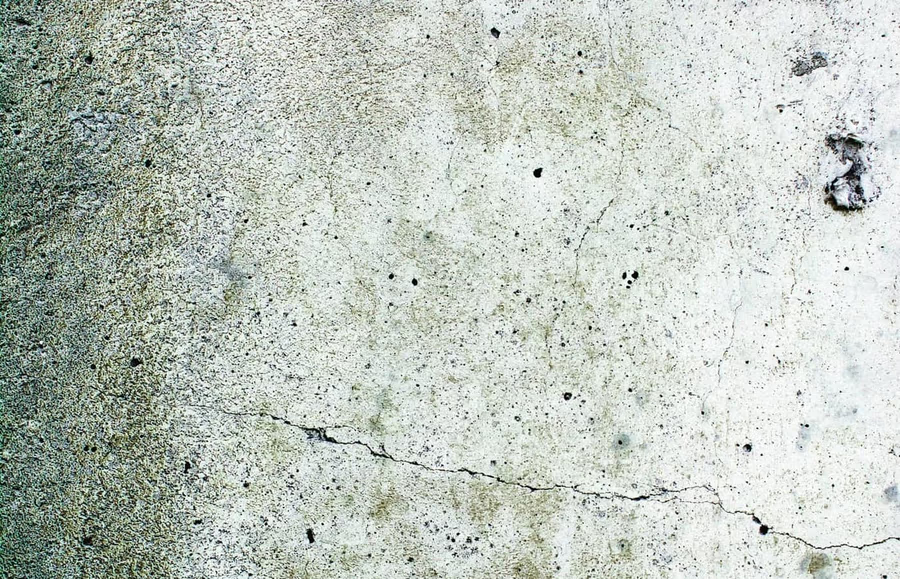
A narrow vertical or near-vertical crack in a poured concrete wall is the most common crack there is, and usually the least interesting. Concrete shrinks as it cures, and shrinkage cracking appears in houses that have never moved a millimetre. It typically runs fairly straight, stays roughly the same width along its length, and is narrow enough that a coin will not go into it.
It still matters for one reason: it is a water path. A shrinkage crack below grade will happily conduct groundwater into a basement or crawl space, and the repair for that is injection, usually polyurethane because it tolerates a damp crack. That is a waterproofing job, not a structural one, and it should be priced accordingly.
Stepped diagonal cracks
In a block or brick wall, movement travels through the mortar joints because that is the weakest path, which produces a staircase pattern rising diagonally. This is the signature of differential settlement: one part of the wall has moved down relative to another, and the masonry has separated along the line of least resistance.
Two details make it more informative. First, direction of widening. A stepped crack that is wider at the top is telling you the movement is at the bottom of that section; wider at the bottom points the other way. Second, position. Stepped cracking near a corner is extremely common because corners concentrate stress, and because a corner is where a footing is most likely to bridge from one bearing condition to another, which on ground like this county's is a routine occurrence rather than a rare one.
Patching a stepped crack in block with surface mortar is the most common cosmetic mistake in this category. It looks resolved for roughly a year.
Horizontal cracks
A horizontal crack running across the middle of a foundation wall is a different mechanism entirely, and it is the one worth acting on promptly. It means the wall is bending inward under lateral pressure from the soil outside, not that the house is settling. Saturated soil is heavier than dry soil and, where it contains expansive clay, is also swelling, so the load peaks at the end of a wet stretch.
Block walls show it first, because a stacked assembly resists bending through its mortar joints rather than through continuous reinforcement. The crack usually appears near mid-height, and above it the wall leans in. Poured walls do it too, later and less obviously.
The critical practical point: piers do nothing for this. Underpinning addresses downward movement, and this is horizontal. A quote that proposes piers for a horizontal mid-height crack has misread the wall. The correct repair is reinforcement plus reduction of the water load, covered in settlement or soil pressure and in the bowing wall page.
Cracks from window and door corners
Openings concentrate stress, so movement in a wall very often announces itself as a diagonal crack running out from the corner of a window or door. In the living space above, the same mechanism shows as drywall cracking at the corner of a door frame, which is why an interior crack in that position is worth taking more seriously than an interior crack in the middle of a wall.
On new houses there is a benign version of this. Framing lumber dries and shrinks, plaster and drywall settle, and fine cracking at opening corners in the first year or two is normal enough that most builders' warranties address it explicitly. The distinguishing question is the same as always: is it still moving.
Width, and what the numbers mean
Width is the single most useful measurement, and almost nobody records it. Rough working bands used across the trade:
- Hairline, under about 1 mm. Very common, usually shrinkage or minor movement. Record and watch.
- About 1 to 3 mm. Worth measuring properly and monitoring. Direction matters more than width at this scale.
- Wide enough to admit a coin, roughly 5 mm and up. Worth having looked at, whichever way it runs.
- Any crack with displacement, meaning one side sits proud of the other, or where the wall is out of plane. Displacement indicates movement rather than shrinkage regardless of width.
Treat those as prompts for attention, not as a diagnosis. A 1 mm horizontal crack across mid-height is more significant than a 4 mm vertical shrinkage crack, because mechanism outranks size.
How to record a crack properly
Twenty minutes of work here will change the quality of every conversation you have afterwards.
- Photograph twice. One wide shot showing where the crack sits on the wall and how it relates to openings and corners, then one close shot with a coin, ruler, or tape measure in frame beside it. Scale is what makes the photograph useful to somebody who is not standing there.
- Measure the widest point with a crack gauge or a ruler with millimetre markings, and note whether the width changes along its length.
- Mark and date the ends. A pencil line across each end with the date beside it makes any extension obvious later, and costs nothing.
- Repeat after a season. Photograph and measure again after a wet spell and again after a dry one. On this ground the moisture cycle is the driver, so a crack that is unchanged across a full year is behaving very differently from one that widened between February and September.
For anything you genuinely need to settle, a tell-tale, meaning a simple two-part gauge fixed across the crack, gives a readable measurement over months. It is cheap, it is low-tech, and it answers the question that determines everything else about the repair.
What else to look at while you are there
A crack rarely tells the whole story on its own. Corroborating signs that point toward genuine movement:
- Doors or windows that bind on one side of the house but operate normally on the other
- A floor that slopes consistently toward one area, checkable with a marble or a long level
- Gaps opening between skirting or trim and the wall, or between cabinet runs and the ceiling
- Exterior brick veneer separating slightly from window frames or from a porch
- A chimney or porch pulling away from the main structure, which frequently moves independently because it sits on its own footing
Signs that point away from it: cracking that appears equally on every wall, cracking confined to drywall in a house under two years old, and cracking that has been painted over at some point in the past and has not reopened.
When to stop reading and call somebody
Sooner rather than later if a crack is horizontal at mid-height, if a wall is visibly out of plane, if anything has changed measurably in the last twelve months, or if water is coming through. Otherwise, recording it properly and looking again after a season is a perfectly reasonable first step, and it costs nothing but a note in a calendar.
When you do call, bring the photographs and the measurements. An assessment that starts from dated evidence is a materially better assessment than one that starts from a description.
Got photographs and want somebody to read them?
Ring (615) 410-4690, or send the quote form and somebody will ring you. Free either way.