Prevention
Water management around a foundation
Nearly every foundation problem here has water somewhere in its history, which makes drainage the least glamorous item on any quote and the one with the best return. The work runs from the roof down, and the cheapest steps come first.
Foundation marketing is dominated by structural products because structural products are expensive and impressive. Drainage is neither, which is why it gets mentioned last and skipped first. That ordering is backwards. A structural repair installed against an unchanged water problem is a repair with a countdown on it, and a great many houses that were quoted for piers needed a hundred dollars of downspout extension instead.
Step one: the roof, which supplies most of it
Roof water is the largest single input to the soil around a house, and it is concentrated rather than spread. An inch of rain falling on a modest roof produces well over a thousand gallons, and every gallon of it arrives at a handful of downspouts. A downspout discharging at the corner of the house is putting a substantial share of the roof directly into the soil against the foundation, repeatedly, for years.
With 55.92 inches of annual rainfall recorded at the Murfreesboro 5 N station in NOAA's 1991 to 2020 normals, and 16.6 days a year exceeding an inch, that is not a marginal input. What to check:
- Gutters clear, and sized for the roof area they serve
- Enough downspouts, rather than one leader carrying an implausible share of the roof
- Extensions carrying discharge well clear of the wall, not a splash block at the corner
- Where the extension discharges to, since dumping it two meters out onto ground that slopes back toward the house achieves nothing
- Buried discharge lines still flowing, since these silt up quietly and nobody notices for a decade
This is a few hundred dollars of work at most, and on a large number of houses it is the entire fix.
Step two: the ground surface
Positive drainage means the ground falls away from the building so surface water runs off rather than pooling against it. It is the second most commonly recommended and second most commonly ignored piece of foundation maintenance, largely because it looks like landscaping rather than structural work.
Things that quietly reverse it: mulch and topsoil added year after year in beds against the house until the bed sits higher than the surrounding lawn; a patio or path settling toward the wall; a garden bed edged with timber that dams water rather than shedding it; and a downspout extension buried under a bed so that its outlet is now below the surrounding grade.
Correcting grade is soil work rather than construction, and on most lots it is the cheapest genuinely effective intervention after the downspouts.
Step three: below grade
When the roof and the surface are handled and water is still reaching the foundation, the next layer is a drain at the footing. A perforated pipe laid in washed stone beside the footing, with filter fabric over the stone to stop it silting up, collects groundwater and carries it to daylight or to a sump.
Exterior versus interior is the usual decision. An exterior footing drain intercepts water before it reaches the wall, which is the better engineering answer, but it means excavating around the foundation and reinstating everything afterwards, so it is priced accordingly at $10 to $50 per linear foot before the digging and landscaping. An interior perimeter drain collects water that has already arrived and routes it to a sump, at $40 to $100 per linear foot but with far less disruption to what is outside. Access, landscaping, and the depth of the wall usually decide it more than theory does.
Sumps. A sump pump needs a check valve so water does not run back down the line, a sealed lid so the pit does not become a humidity source, and a discharge routed well away from the foundation rather than around the corner where it re-enters the soil. Whether it needs a battery backup depends on consequences: the storms that produce the most water are also the ones most likely to take the power out, so a mains-only pump has a gap exactly when it matters. If a failure means a damp unfinished floor, most people accept that. If it means finished rooms, the backup is cheap insurance.
The local complication: water on rock
On most ground, rain soaks in and continues downward. Across large parts of Rutherford County it cannot, because there is not much soil to soak into. The USDA soil survey records bedrock as shallow as ten inches across the county's largest soil map unit, and bare rock outcrop as a major component on roughly eleven percent of the county.
Water passing through thin soil meets an effectively impermeable surface and then travels sideways along it. On sloping ground that means water arriving at a foundation laterally, from uphill, in volumes that have nothing to do with what fell on that particular lot. It also means a foundation can take water from a source that is not visible from the house.
The City of Murfreesboro's own description of the local karst adds another layer: limestone dissolved into fissures, caves and seams, with water moving through them as though they were pipes. Groundwater in that setting does not always follow surface topography, which is why a wall that is damp at one point every spring sometimes has no obvious catchment above it at all.
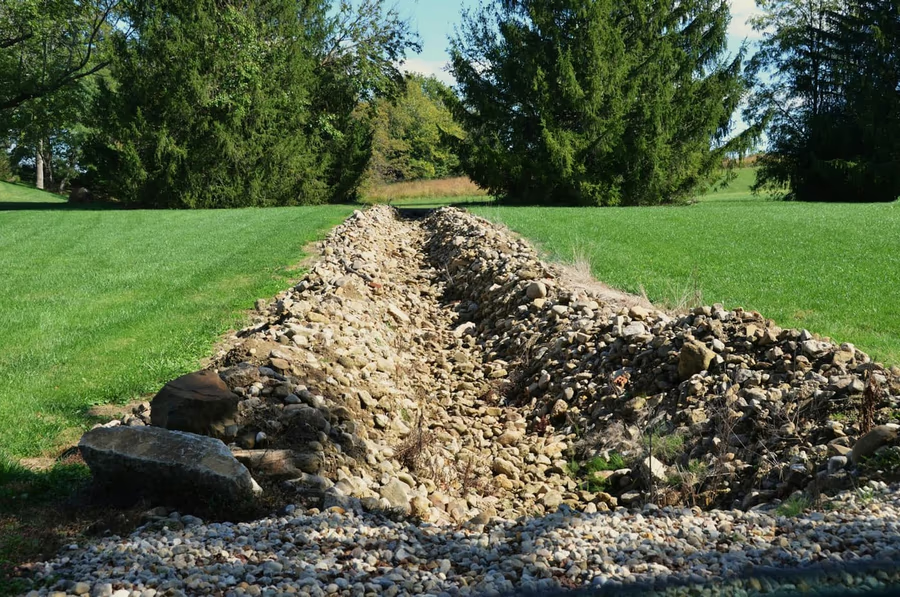
The practical response is interception uphill rather than defense at the wall: a swale, a curtain drain, or a re-graded route that takes water around the building before it gets there. It is one of the few situations where the effective drainage work happens nowhere near the foundation.
The seasonal picture
NOAA's normals for the Murfreesboro 5 N station show the wettest month is June at 5.68 inches and the driest is October at 3.46 inches, with December close behind June at 5.54. That is a soil that gets loaded through the winter and spring, then dries hard through late summer and autumn while temperatures are still high.
Across years the swing is larger. The same station recorded 40.36 inches in 2007 and 70.72 inches in 2020 and again in 2021. Clay with linear extensibility approaching ten percent, cycled through a thirty-inch difference in annual moisture, is doing real work on whatever sits on it. Drainage is how you flatten that cycle, and flattening the cycle is how you stop the movement rather than repairing it repeatedly.
A walkaround worth doing
- Go out in heavy rain. Not afterwards. Watching where water runs takes ten minutes and beats any amount of dry-weather reasoning.
- Follow every downspout to where it discharges, and then follow the water from there.
- Check the grade on all four elevations, using a level on a straight board where the eye cannot tell.
- Look uphill for anything delivering water toward the house: a slope, a neighbor's driveway, a blocked swale, or a spot where water emerges from the ground after rain.
Those four observations answer more diagnostic questions than most first visits, and they make any subsequent conversation about structural work far better informed. The drainage and waterproofing page covers what the work itself involves, and the cost guide puts numbers on it.
Water arriving somewhere it should not?
Ring (615) 410-4690, or send the quote form and somebody will ring you. Free either way.